
Direct Answer
Every law firm has a professional responsibility to protect confidential client information, but cybersecurity isn't governed by a single checklist. Instead, firms should understand how ethical obligations, state privacy laws, cyber insurance requirements, and industry best practices work together.
For law firms in New York and New Jersey, that generally means implementing reasonable administrative, technical, and physical safeguards to protect sensitive information. While the specific controls vary from firm to firm, most should have Multi-Factor Authentication (MFA), endpoint protection, secure backups, employee security awareness training, email security, and a written incident response plan.
The objective isn't perfect security, it's reducing risk while demonstrating that your firm takes reasonable steps to protect client information.
Why This Matters
Law firms are trusted with some of their clients' most sensitive information, including contracts, financial records, litigation strategies, intellectual property, medical documentation, and personally identifiable information.
A cybersecurity incident can affect far more than your technology.
It can interrupt business operations, delay client work, damage your firm's reputation, trigger breach notification obligations, and potentially affect cyber insurance coverage.
Technology changes, new threats emerge, employees join and leave the firm, and software is updated continuously. Protecting client information requires regular review and improvement, not a one-time investment.
Editor's Insight
One of the biggest misconceptions we see is that cybersecurity is something you "finish."
Installing a firewall or enabling Multi-Factor Authentication is important, but those are milestones, not the destination. Cyber threats evolve, employees change, software is updated, and new vulnerabilities are discovered regularly. In our experience, firms are better protected when cybersecurity becomes part of their routine operations rather than a project that gets completed and forgotten.
A Practical Cybersecurity Framework for Law Firms
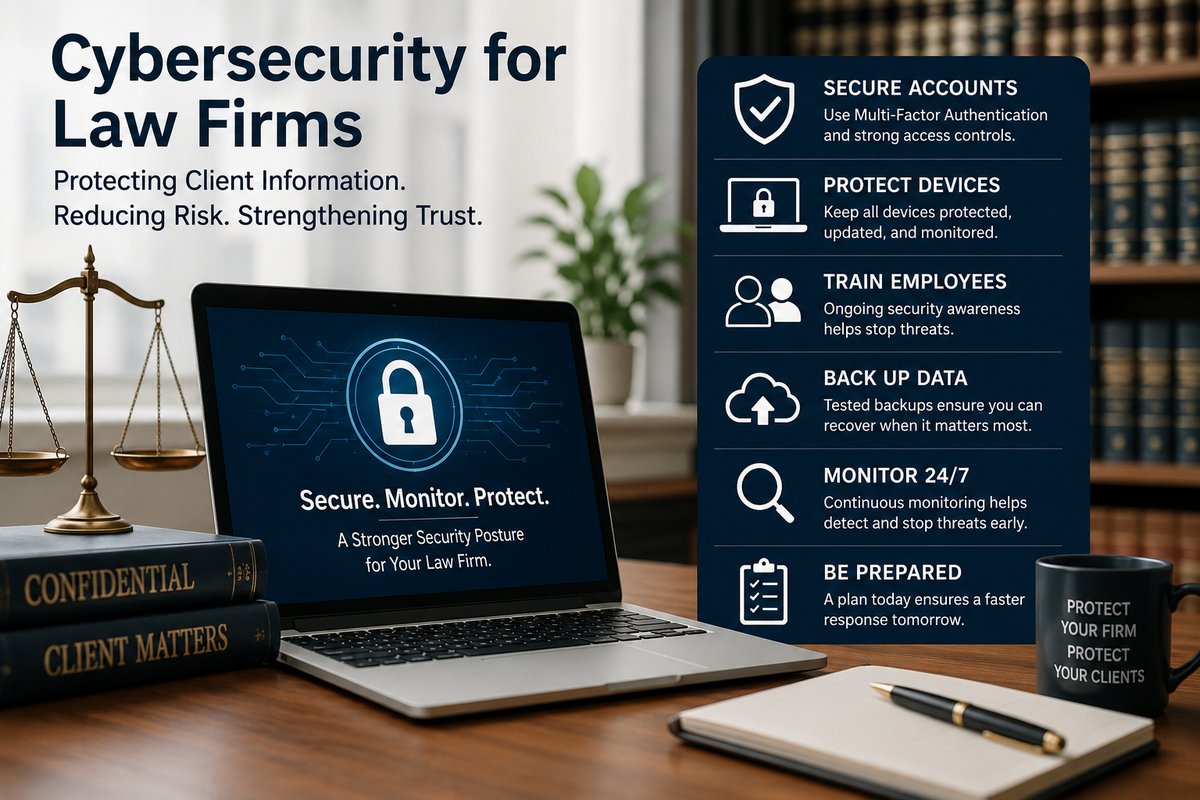
Rather than trying to follow dozens of different recommendations, we encourage law firms to focus on six core areas.
1. Secure Your User Accounts
Every user account that accesses your firm's technology should be protected with strong authentication and appropriate security controls.
Require Multi-Factor Authentication (MFA) for:
- Microsoft 365
- Remote access
- Cloud applications
- Password managers
Check whether your password has appeared in a known data breach by using Have I Been Pwned.
2. Secure Every Device
Every workstation and laptop should have:
- Endpoint Detection and Response (EDR)
- Managed antivirus
- Disk encryption
- Automatic security updates
- Device monitoring
Whether attorneys work from the office, home, or court, every device should receive the same level of protection.
3. Train Your Employees
Technology alone cannot stop phishing attacks.
Employees should receive ongoing security awareness training that teaches them how to recognize:
- Phishing emails
- Business email compromise
- Fake login pages
- Social engineering attempts
- Suspicious attachments
Security awareness isn't about blaming employees, it's about preparing them.
4. Protect Your Data
Every law firm should have:
- Automated backups
- Encrypted backups
- Off-site or cloud backups
- Regular backup testing
- A documented recovery process
Backups only provide value if they can actually be restored.
5. Monitor Your Environment
Good cybersecurity isn't passive.
Your systems should be monitored for:
- Suspicious logins
- Failed authentication attempts
- Malware activity
- Unusual network behavior
- Security alerts
Early detection often prevents small incidents from becoming major business disruptions.
6. Prepare for the Unexpected
Every firm should know:
- Who to call after a cyber incident
- How systems will be restored
- How employees should respond
- How clients will be informed if necessary
A written incident response plan reduces confusion during a stressful situation.
What About Compliance?
Technology supports compliance, but compliance requirements come from multiple sources.
Depending on your firm, these may include:
- The NY SHIELD Act
- ABA guidance regarding technology competence and protecting client information
- Cyber insurance requirements
- Client contractual obligations
For firms maintaining private information about New York residents, The NY SHIELD Act requires organizations to develop, implement, and maintain reasonable administrative, technical, and physical safeguards.
For the official requirements and guidance, see the New York Attorney General's SHIELD Act page:
New York Attorney General – The NY SHIELD Act Guidance
Cybersecurity Isn't Just About Software
Many firms begin by asking:
"Which cybersecurity software should we buy?"
A better question is:
"How do we reduce our firm's overall risk?"
Technology is only one part of the answer.
Policies.
Processes.
Employee training.
Regular reviews.
Ongoing maintenance.
Together, these create a stronger security posture than software alone.
Questions We Hear From Law Firms
Is Microsoft 365 secure enough by itself?
Microsoft 365 provides a secure foundation, but it doesn't automatically configure every recommended security setting. Features such as Multi-Factor Authentication, Conditional Access policies, email protection, and data security settings should be reviewed and configured based on your firm's needs.
We're a small law firm. Are we really a target?
Yes.
Cybercriminals often target smaller organizations because they may have fewer dedicated security resources while still maintaining valuable client information. Firm size doesn't determine whether attackers will attempt to compromise your systems, so every law firm should take reasonable steps to reduce risk.
How Avenue M Helps
Avenue M Computers helps law firms throughout New York and New Jersey build practical cybersecurity programs that support both business operations and client trust.
Rather than focusing on individual security products, we help firms develop layered protection through proactive monitoring, endpoint security, Microsoft 365 management, employee awareness training, backup strategies, and ongoing technology planning.
Our goal is to reduce risk without making technology more complicated for attorneys and staff.
Key Takeaways
- The objective isn't perfect security, it's reducing risk while demonstrating that your firm takes reasonable steps to protect client information.
- Strong cybersecurity combines secure technology, employee awareness, documented processes, and regular review.
- Protecting client information requires continuous improvement, helping your firm reduce operational risk while maintaining client confidence.
Related Articles
- How Much Does Managed IT Cost for a 10–25 Employee Law Firm in New York or New Jersey?
- How Often Should Law Firms Test Their Backups?
- Why Is Multi-Factor Authentication (MFA) Essential for Law Firms?
- What Is The NY SHIELD Act, and How Does It Affect Law Firms?
Technology should help your law firm practice law more securely, efficiently, and confidently, not become another distraction.